Australia’s seasonally adjusted unemployment rate rose to 4.9 per cent in October 2026 from 4.7 per cent in September, the highest since October 2021, as the number of employed people fell by 43,500, the Australian Bureau of Statistics reported on Thursday 19 November.
The number of unemployed people rose by 17,800 to 753,700, the ABS said. ABC News reported that the result took analysts by surprise, and The Guardian reported that it confounded forecasts of jobs growth and a steady rate.
How worried are you about job security heading into 2027?
Choose an answer, then select Vote.
The Detail Behind the Rate
Employment fell by 43,500 people, or 0.3 per cent, to 14,738,600 in seasonally adjusted terms. Full-time employment fell by 2,900 to 10,228,700 and part-time employment fell by 40,600 to 4,509,900, according to the ABS.
The unemployment rate was 5.0 per cent for men, up 0.1 percentage points, and 4.7 per cent for women, also up 0.1 percentage points. Youth unemployment, covering people aged 15 to 24, rose to 11.3 per cent from 11.1 per cent in September. That is the highest since October 2021, and since May 2022 the youth rate has averaged 9.2 per cent, the ABS said.
The employment-to-population ratio fell 0.3 percentage points to 63.3 per cent, and the participation rate fell 0.2 percentage points to 66.6 per cent. The underemployment rate fell 0.1 percentage points to 6.2 per cent, while the underutilisation rate stayed at 11.1 per cent. Monthly hours worked in all jobs decreased by 3.6 million to 2,006 million.
Victoria
In Victoria the seasonally adjusted unemployment rate was 5.4 per cent, up 0.3 percentage points, according to the ABS state table. Employment in the state rose 0.1 per cent to 3,825,800 people, and Victoria’s trend unemployment rate was 5.2 per cent, unchanged on the month.
The ABS noted that for October it adjusted the influence of about 1,390 respondents, about 2.7 per cent of the sample, in one rotation group in Victoria.
The other seasonally adjusted state rates were 4.6 per cent in New South Wales, 4.8 per cent in Queensland, 4.8 per cent in South Australia, 4.5 per cent in Western Australia and 5.4 per cent in Tasmania. For more on the state’s economy, wrp has also covered Victoria’s finances in the budget update published on 30 October.
What the ABS Says About One Month
The ABS surveyed households from 27 September to 10 October 2026. It said it “recommends exercising a degree of caution in interpreting short-term changes”, and that the trend data “provides the best measure of the underlying behaviour of the labour market”.
In trend terms the unemployment rate rose 0.1 percentage points to 4.8 per cent, and trend employment was steady. ABC News reported that the ABS revised September’s trend rate from 4.6 to 4.7 per cent.
“Employment remained steady in trend terms, meaning there was very little underlying growth in the number of employed people,” Sean Crick, the ABS head of labour statistics, said in the release of 19 November.
What the Numbers Mean for Rates
The Reserve Bank raised the cash rate for the fifth time this year on Tuesday 3 November, Melbourne Cup day. ABC News reported that the rise had no bearing on the October figures, because the rise in unemployment came before it.
The Guardian reported that three board members dissented against that decision and warned of a “materially sharper downturn”. It also reported that markets moved to price out a sixth rise and, according to National Australia Bank, were factoring in a cut by September 2027. ABC News reported on 19 November that economists expected rates to stay on hold until at least February 2027. The Reserve Bank’s last meeting of 2026 is in December.
David Bassanese, the chief economist at BetaShares, told The Guardian: “If these employment declines prove to be real, however, they’re the type of weakness that could well mean we’ve seen the last interest rate hike,” and added: “Indeed, consecutive large employment declines might suggest the economy already has one foot in recession.”
“For the RBA, this lands on a board already split over whether policy has gone far enough,” Sunny Nguyen of Moody’s Analytics told The Guardian.
On the day of the release, Thursday 19 November, Bassanese wrote, according to ABC News: “The RBA has time on its hands to wait to see whether today’s evident employment weakness truly means the economy is buckling, as it has hoped it would, or is just statistical noise due to changes in the way the labour force survey is conducted.”
The Reserve Bank’s most recent forecasts have unemployment rising for two years to 5.1 per cent by the end of 2028, ABC News reported. NAB senior economist Taylor Nugent told The Guardian: “We had been expecting peak unemployment to peak at around 5.5% by the end of next year.” NAB’s expected peak was for the end of 2027.
Cassandra Goldie, the chief executive of the Australian Council of Social Service, said, according to ABC News: “Australia is staring down a materially sharper downturn and at worst a recession,” and called on the Reserve Bank not to raise rates again.
The next release, Labour Force, Australia, November 2026, is due on Thursday 17 December 2026. More money coverage is in our Financial archive.
Sources: Australian Bureau of Statistics, “Labour Force, Australia, October 2026”, 19 November 2026 (https://www.abs.gov.au/statistics/labour/employment-and-unemployment/labour-force-australia/oct-2026); Australian Bureau of Statistics, “Unemployment rate rises to 4.9%”, 19 November 2026 (https://www.abs.gov.au/media-centre/media-releases/unemployment-rate-rises-49); ABC News, “Unemployment rate surges to 4.9pc in October, taking analysts by surprise”, 19 November 2026 (https://www.abc.net.au/news/2026-11-19/unemployment-rate-jumps-in-october-in-australia/107399076); The Guardian, “Australia may have ‘one foot in recession’ as unemployment surges to five-year high”, 19 November 2026 (https://www.theguardian.com/business/2026/nov/19/unemployment-rate-jumps-highest-level-five-years-job-figures)
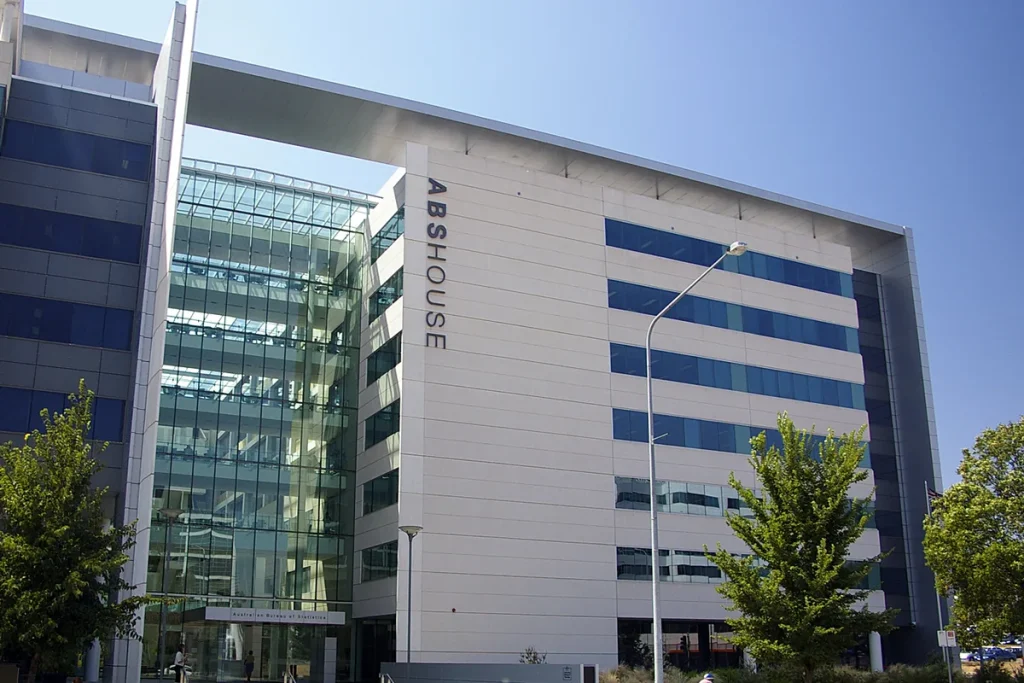
Photo: Bidgee, CC BY-SA 3.0, via Wikimedia Commons.
ABS House at Belconnen in Canberra, headquarters of the Australian Bureau of Statistics, photographed in February 2009.