
Surcharges on card payments end on Thursday, 1 October. From that morning, in store and online, a business can no longer charge a customer extra for paying by debit, credit or prepaid card on the eftpos, Mastercard or Visa networks.
Card payments still work, and the change is not a windfall for every shopper. The cost of taking a card has to be carried, and businesses are working out where.
Card surcharges end on 1 October. Will it change how you pay?
Choose an answer, then select Vote.
What Ends, and What Does Not
The Reserve Bank’s Payments System Board announced the change at the end of March after a review of what merchants pay to accept cards, with six months’ notice. American Express, JCB and UnionPay have said they support the reform and are working to remove surcharging from the same date.
Weekend and public holiday surcharges stay legal, and so do booking fees and service fees. The trap is a fee charged only to card customers: a card-only booking fee is a surcharge under another name.
Enforcement runs through the card networks’ rules rather than the regulator. The Reserve Bank has directed the acquirers serving merchants to remove the surcharging function from terminals.
The Discount Route
The Australian Competition and Consumer Commission has confirmed what a business may do instead. It says a business may offer a discount for paying by cash or another method such as PayID, provided the price on display is the full price a customer pays without the discount, and the discount is disclosed before the customer chooses how to pay.
In effect, a business can reward cash but cannot quietly punish a card. The same regulator’s cash acceptance rules, in force since 1 January, require supermarkets and petrol stations to take cash for in-person payments of $500 or less, with small businesses under $10 million turnover exempt.
What Businesses Get Back
On the same day, the interchange cap on domestic consumer credit cards falls from 0.8 per cent to 0.3 per cent, and on debit cards from 0.2 per cent to 0.16 per cent. Interchange is the fee a merchant’s bank pays the cardholder’s bank.
The Australian Banking Association, an industry group with an interest in the outcome, cites the Reserve Bank’s expectation that lower payment costs will offset the lost surcharge revenue by about $660 million a year, with total business savings of about $910 million. Those are the Reserve Bank’s figures, relayed by a party that benefits from them.
Where the Cost Goes Instead
The Reserve Bank’s own estimate is that consumers pay about $1.6 billion a year in surcharges, and that only about 16 per cent of businesses levy one. Every business in that group has to recover the money somewhere: absorb it, build it into the shelf price so every customer pays a little, or offer a discount to those who pay another way. The Reserve Bank estimates a one-off effect of about 0.1 per cent on measured inflation if the costs go into prices instead.
The card surcharge should be gone from the receipt, while weekend and public holiday surcharges can still appear.
Cash use has fallen sharply. The same regulators are now pointing at cash as a legitimate way to steer customers. Cash advocates expect more discounts and more cash-only signs, while industry groups warn of price rises and bill shock.
Shoppers who have paid a surcharge will not get that money back. Refunds to Prime members followed the US$2.5 billion settlement that ended the US Federal Trade Commission’s case against Amazon, money returning by a different route. From Thursday, the change shows up in the price instead.
Nobody yet knows which way the majority of businesses will go. The first real evidence will be the prices on the shelves in October.
Sources: Reserve Bank of Australia, Payments System Board conclusions on merchant card payment costs and surcharging, March 2026; Treasurer of Australia, “Ending card surcharges to help with the cost of living”, March 2026; Australian Competition and Consumer Commission, card surcharges guidance; The New Daily, “How the card surcharge ban will affect you at the checkout”, 25 September 2026; Nine.com.au, “Businesses open to discounts for cash purchases as card surcharge ban looms”, 23 September 2026
Photo: Mikarbo02, CC BY-SA 4.0, via Wikimedia Commons.
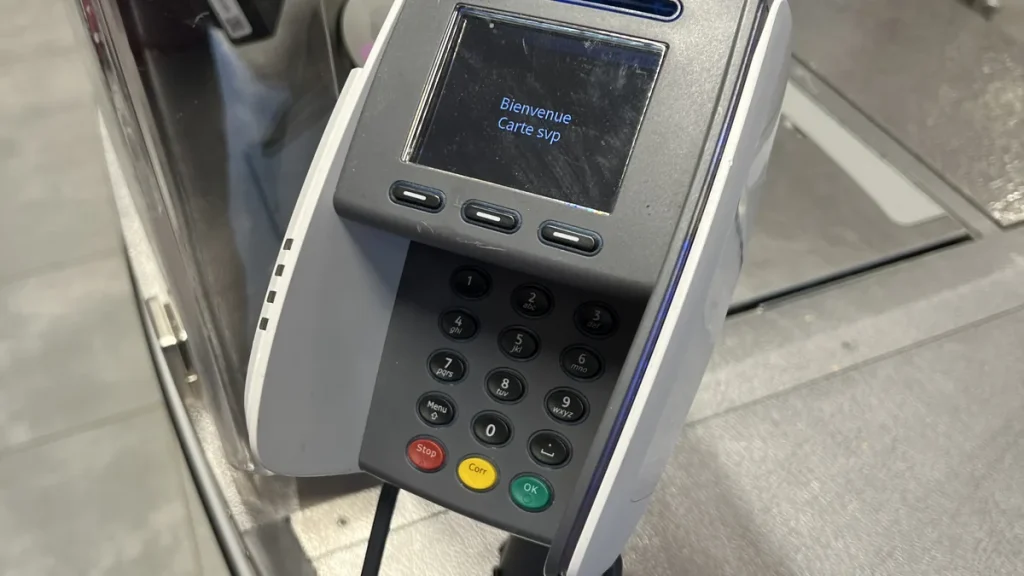
Illustrative: a card payment terminal with a screen and keypad, of the kind used at shop checkout counters. This is a stock photograph of a terminal and is not a photograph of any business, venue or person named in this article, and it does not show any surcharge being applied.