On Friday 30 October, Treasurer Colin Brooks released the 2026 Victorian Economic and Fiscal Update, and its central number is a $5.1 billion cut to state tax revenue. The update lands less than a month before the state election on 28 November.
The downgrade runs across the budget and forward estimates to 2029-30, an average of $1.3 billion a year, and is measured against the 2026-27 Budget handed down in May, according to the Department of Treasury and Finance.
The update puts the fall down to property.
“This is primarily driven by downgrades to land transfer duty and land tax, reflecting a decline in property market activity amid higher interest rates and other factors.”
Is the cooling property market changing your plans to buy or sell in Victoria?
Choose an answer, then select Vote.
Where the Revenue Went
Property prices and transaction volumes were hit by four interest rate rises between February and September 2026, the update says. Land transfer duty, better known as stamp duty, is forecast at $9.2 billion in 2026-27, down from 2025-26. Land taxes are forecast at $7.6 billion.
The department does expect a recovery. Duty is forecast to rebound and grow by an average of 9.2 per cent a year over the forward estimates.
For the wider economy, real gross state product is forecast to grow 1.00 per cent in 2026-27, and unemployment was 5.1 per cent in September 2026, according to the update.
Surpluses, Debt and Interest
The state is still forecasting operating surpluses, averaging $0.3 billion a year. ABC News reported that this compares with the $1 billion forecast in the May budget. Operating cash surpluses average $5.7 billion a year, the update says.
The document makes a point of the comparison with its neighbours.
“Victoria is the only state on the eastern seaboard to be forecasting a surplus in all four years of the budget and forward estimates period.”
Net debt is forecast at $173.5 billion at June 2027 and $197.0 billion by June 2030. That June 2030 figure is $2.3 billion lower than the May budget forecast.
Carrying the debt costs more each year. Interest expense is forecast at $8.9 billion in 2026-27, rising to $12.0 billion by 2029-30. ABC News put the bill at $24.3 million a day.
The Risks and the Savings
The update names several risks, including these two. The first is the federal migration changes announced in September 2026.
“If net overseas migration declines by more than currently expected, this could weigh on the longer-term economic outlook for the state through fewer consumers, lower education exports and a smaller pool of workers,” the update warns, as quoted by ABC News.
The second is fuel and material costs linked to the Middle East conflict, which could hit infrastructure projects.
On the spending side, the government has found an additional $471 million in gross savings. They include a smaller vehicle fleet, less spending on consultants and labour hire, a cap on barrister fees, and the abolition of Infrastructure Victoria, the Suburban Rail Loop Authority and Economic Growth Victoria.
A further $1.3 billion of capital spending is deferred by resequencing level crossing removals on the Upfield and Frankston lines.
ABC News also reported that the myki surcharge uncovered by the auditor-general will formally end on 1 January 2027.
What It Means Before 28 November
Brooks, who became treasurer in August 2026, pointed to a $2.4 billion operating surplus in 2025-26, ABC News reported. He framed the downgrade as a national problem.
“This is something that’s impacting the whole country, driven by inflation, interest rates and also some changes in the federal budget settings as well,” he told media.
Not everyone reads it that way. “Victoria’s finances are deteriorating and economic headwinds are accelerating,” said Martin Codina, executive director of Amplify, according to ABC News.
A separate auditor-general review, tabled on 30 October, found the state still records operating cash deficits and called for a long-term approach to budget repair, ABC News reported.
Land tax is already part of the campaign. Premier Ben Carroll has vowed to reverse the 2023 land tax increases if Labor is re-elected, according to ABC News. For anyone weighing a property move, the update’s own forecast is that duty rebounds over the forward estimates. Victorians vote on 28 November.
More finance coverage is in our Financial archive.
Sources: Department of Treasury and Finance, “2026 Victorian Economic and Fiscal Update”, October 2026 (https://www.dtf.vic.gov.au/2026-victorian-economic-and-fiscal-update); ABC News, “Cooling property market wipes $5 billion from Victorian budget forecasts”, 30 October 2026 (https://www.abc.net.au/news/2026-10-30/vic-budget-update-property-market-fall-debt/107327810)
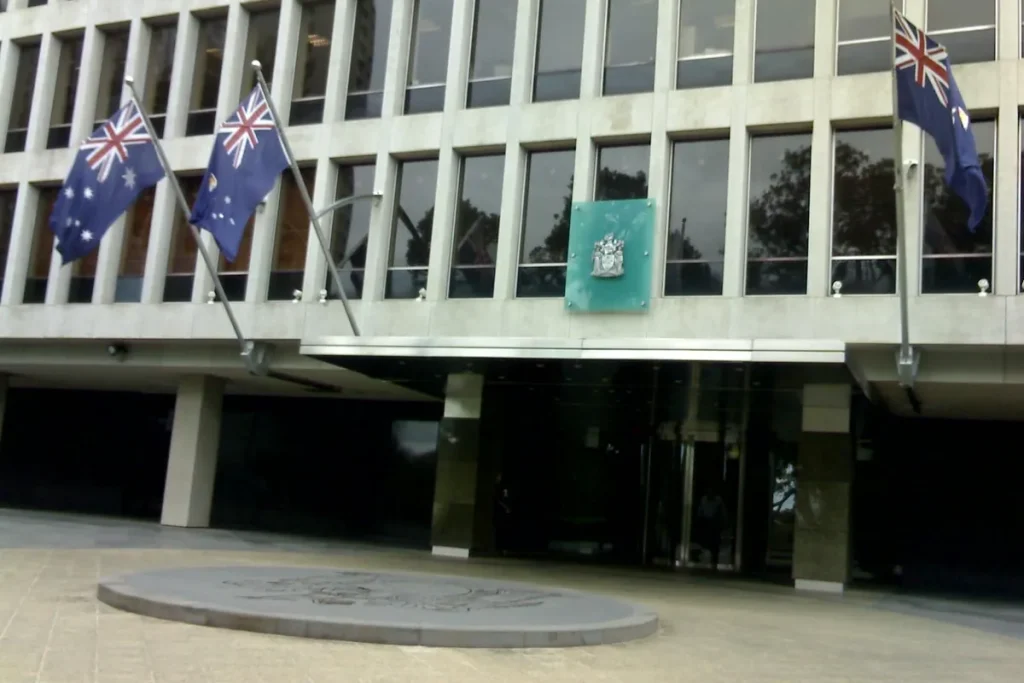
Photo: Dtfman, CC0, via Wikimedia Commons.
The entrance of 1 Treasury Place, Melbourne, the government building that houses the Treasurer’s office and the Department of Treasury and Finance.