The cash rate now sits at 4.60 per cent, the highest level since 2011, after the Reserve Bank of Australia’s Monetary Policy Board lifted it by 25 basis points on 29 September. The vote was unanimous. It was the fourth increase of 2026, and the new rate applies from 30 September. The move ended the run of holds in June and August.
The decision comes against a cooling housing market and an easing labour market, and the Board’s statement records both. Its case for tightening anyway rests on three forces it says are pushing prices up.
The RBA has lifted rates again to bring inflation down while the economy is slowing. Is that the right trade-off for now?
Choose an answer, then select Vote.
Three Forces the Board Named
The first force is global energy. The conflict in the Middle East has broadened, and the Board says global energy prices are now “much higher than had been assumed in the August forecasts”. Some of the higher fuel costs have already flowed into other goods and services. In the statement’s words: “some of the upside risks to inflation are materialising”.
The second is AI-related demand. The Board points to the artificial intelligence boom as a force lifting global technology goods prices, and in comments after the meeting the Governor said it has partly driven up prices for technology-related goods and is adding to demand in Australia as well. The Governor placed the boom among her three big risks.
The third is domestic capacity. Firms are reporting cost increases, and some are raising prices or planning to. Short-term inflation expectations are elevated. The problem, in the Governor’s phrase, is “too much money chasing too few goods”.
The Data Under the Decision
Inflation sits above target on both main measures. The trimmed mean, the gauge the Board watches most closely, was 3.6 per cent over the twelve months to July, and the headline rate was 3.5 per cent, the Australian Bureau of Statistics reported in figures released on 26 August. The target is 2 to 3 per cent.
Growth is the complication. The economy grew 2.1 per cent over the year to June, stronger than expected, as Investor Daily reported. The labour market is easing broadly, which the Board had expected. In housing the cooling is plain: prices are down in most capital cities and new housing loans have declined noticeably, the Board says.
For borrowers the cost shows up monthly. Canstar’s estimate, reported by The New Daily, is about $91 a month more on a $600,000 loan, and about $364 a month in total across this year’s four increases. One household cost is moving the other way: the surcharge ban starting on 1 October, set by the Reserve Bank’s Payments System Board, ends the fee for paying by card.
What to Watch Before the Next Decision
The Board has named what it is watching: the conflict and oil supply scenarios, weak productivity weighing on growth, and the effects of the housing downturn. It has also reserved the right to move again. The statement says it will do what it considers necessary, “including increasing the cash rate target further if needed”. Asked whether this increase would be enough, the Governor replied: “The hope here is that this will be restrictive enough. Now, will it be enough? I don’t know.”
The first test is the August inflation update, due on 30 September. Beyond that, the forecasts diverge. ANZ projects a cash rate of 4.85 per cent in November. RBC BlueBay calls another increase “near unavoidable”. AMP’s Shane Oliver expects “one hike, and then remain hawkish”, and warns that further rises could deepen the housing downturn. Each is that forecaster’s view, not the Bank’s.
The Board has committed to nothing beyond doing what it considers necessary, and it has not said this is the end of the tightening. Its watching brief is specific: inflation first, then housing and the labour market, with the conflict overseas still shaping energy prices.
Sources: Reserve Bank of Australia, “Statement by the Monetary Policy Board: Monetary Policy Decision”, 29 September 2026; Australian Bureau of Statistics, Consumer Price Index, Australia, July 2026; The New Daily, “More pain for borrowers as RBA lifts rates for fourth time”; SBS News, “What’s worrying the RBA now? The risks it couldn’t ignore”; Investor Daily, “RBA decision shifts the economic outlook again”
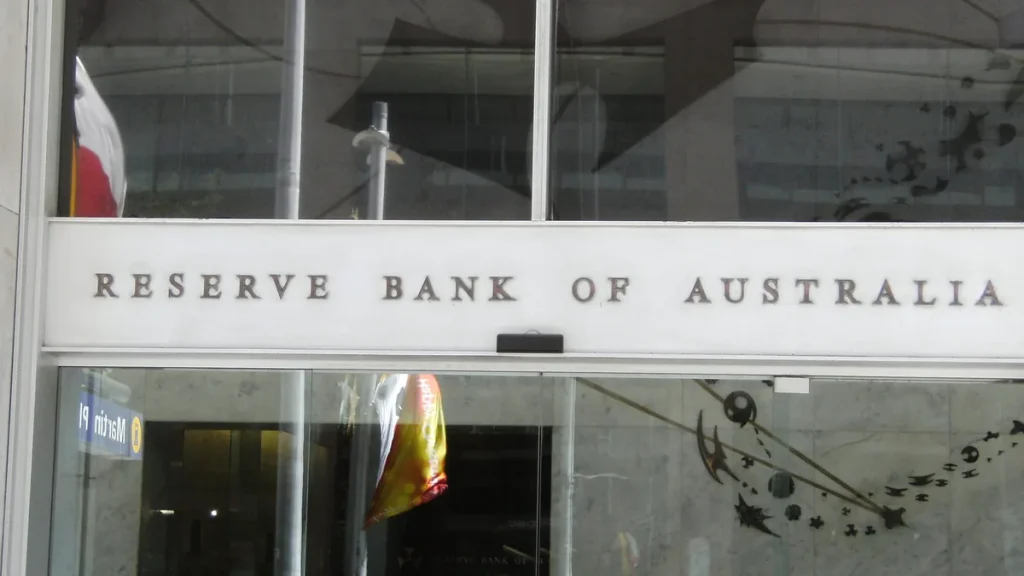
Photo: Danausi, public domain, via Wikimedia Commons.
The Reserve Bank of Australia sign at its Martin Place head office in Sydney. The Board’s 29 September 2026 decision lifted the cash rate target to 4.60 per cent; the photograph does not show the meeting or the announcement.