
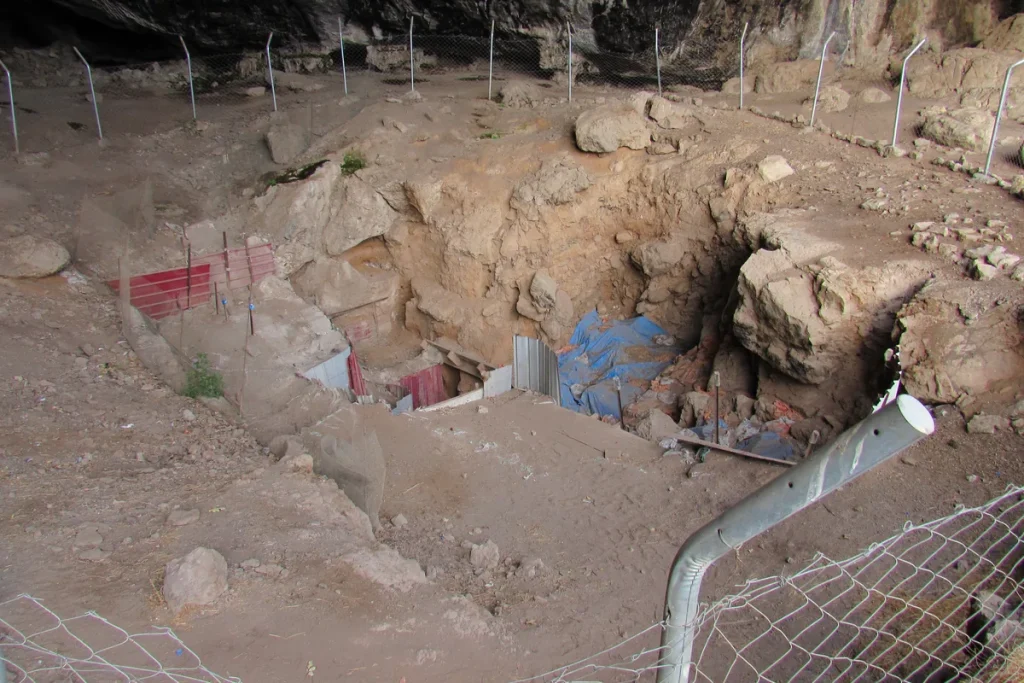
A neat round hole in a Neanderthal’s shoulder blade, found in Shanidar Cave in Iraqi Kurdistan, may be the oldest known evidence of a human relative killed with a wooden spear, researchers say.
The research, by a UK and Spanish team, is published in Scientific Reports, ABC News reported. The study came out on Thursday 15 October, UK time. The remains, known as Shanidar A, are of a Neanderthal man in his 40s and are about 75,000 years old.
Neanderthals, a separate species of humans, lived across Europe and western and central Asia and went extinct around 40,000 years ago, BBC News reported.
The Wound
The 15mm hole in the shoulder blade could be the earliest evidence of lethal violence involving a wooden spear, according to BBC News. The researchers believe the spear entered the chest and passed through the body, probably damaging a lung and major blood vessels, before exiting through the left shoulder blade.
“The fatal strike may have been an intended heart shot,” Dr Emma Pomeroy, of the University of Cambridge, told BBC News.
“It is not the kind of break that you would get naturally, because it is so circular,” she said. “Experiments with reconstructed wooden spears produce very similar round holes in bone.”
Wooden spears 200,000 to 400,000 years old have been found in Europe, ABC News reported, but at Shanidar the wood has not survived.
A Burial Behind the Boulder
The bones were excavated from under nearly 8 metres of rock and sediment, The Guardian reported. At least five Neanderthals were buried at the same spot over several years, in a depression no larger than a fridge behind a huge boulder near the cave entrance.
“Their body was placed in a very specific spot in the cave, tucked in behind a huge rock that stood between them and the cave mouth,” Pomeroy said, according to ABC News.
This individual had survived an earlier blow. One lower front tooth was split in half and covered in hardened plaque, ABC News reported. The Guardian said the plaque would have taken at least a year to build up.
Accident or Attack?
Sofia Samper Carro, an archaeologist at the Australian National University who was not involved in the study, said some of the conclusions were “bold”, ABC News reported. She said it was very difficult to know the cause of death unless the weapon was found, though she agreed the circular damage was unusual and not how bones usually break.
“It’s unusual that you get those circular shapes, but correlating that with the cause of death? I think it’s a bit too much,” she said.
Co-author Chris Hunt, emeritus professor at Liverpool John Moores University, said the Shanidar Neanderthals mainly hunted ibex and could have used spears shaped like modern javelins, according to The Guardian. “Conceivably it was a hunting accident,” he said. “We can’t, however, rule out that purposeful interpersonal violence was involved.”
Prof Chris Stringer, of the Natural History Museum, gave his own reading. “The researchers leave it open whether this resulted from a hunting accident or interpersonal violence, but in my view the latter seems more likely, given the positioning and extent of the wound,” he told BBC News.
Remains of at least 10 Neanderthals were found in the cave in the 1950s, and a 1957 find showed another Neanderthal with a partly healed rib wound, probably from a stone-tipped spear, BBC News reported. A 2022 study of skulls from northern Spain’s “Pit of Bones” suggests deadly violence about 430,000 years ago.
“I unfortunately see the growing body of evidence as an indication that interpersonal violence goes deep into human prehistory,” Stringer told BBC News.
The team is still excavating at Shanidar, according to ABC News.
More coverage is in our Environment section.
Sources: ABC News, “Hole punched into Neanderthal’s shoulder launches spear killing debate”, 16 October 2026 (https://www.abc.net.au/news/science/2026-10-16/neanderthal-death-by-wooden-spear-shanidar-cave/107263428); BBC News, “Hole in Neanderthal shoulder bone linked to ancient wooden spear”, 15 October 2026 (https://www.bbc.co.uk/news/articles/c6jrwn3y3xe9o); The Guardian, “Neanderthal remains may be earliest human ancestor find killed by a spear”, 15 October 2026 (https://www.theguardian.com/science/2026/oct/15/neanderthal-remains-human-ancestor-killed-by-spear-iraq-kurdistan-cave-earliest-find)
Photo: Khoshhat, CC BY-SA 4.0, via Wikimedia Commons.
Inside Shanidar Cave in the Kurdistan Region of Iraq, photographed in November 2020; the remains in the study were excavated at this site.