
H5 bird flu has been detected in samples from a southern elephant seal and a kelp gull on Macquarie Island, the subantarctic island that had already been emptied of staff because of the risk.
The samples were collected on the island, brought back with island personnel and tested positive for H5, ABC News reported.
Tasmania’s Minister for Environment and Climate Change, Guy Barnett, said in a statement on Thursday that it was the “first recorded detection in a marine mammal in Tasmania”, according to ABC News.
Should Australia keep a permanent research presence on Macquarie Island through outbreaks like this?
Choose an answer, then select Vote.
What the Federal Minister Told Parliament
Federal Agriculture Minister Julie Collins told parliament that three other species had tested negative, including skuas, giant petrels and penguins, ABC News reported.
She said there had been no signs of any mass mortality events among the island’s wildlife at this stage. The seal and gull samples would undergo further testing at a CSIRO laboratory, she said.
Macquarie Island is 1,500 kilometres south-east of Hobart. It is a World Heritage-listed wildlife sanctuary with up to 4 million seabirds and 100,000 seals, according to ABC News.
Why the Island Was Emptied
In August the ABC reported that the Australian Antarctic Division planned to bring personnel off the island. Expeditioners were brought back amid concerns about the psychological impact of seeing a potential mass mortality event, ABC News reported.
The federal environment department, which runs the Australian Antarctic Program, temporarily withdrew staff from the island’s research station because of the H5 risk. H5 had not been detected there at the time, and expert assessments predicted a high likelihood of a significant mortality event in the breeding season, according to the program.
“While the risk to humans of H5 bird flu is considered low, we can’t ignore the psychosocial risks of living near potentially large numbers of affected animals,” DCCEEW Deputy Secretary Sean Sullivan said, according to the Australian Antarctic Program.
Why Elephant Seals Matter
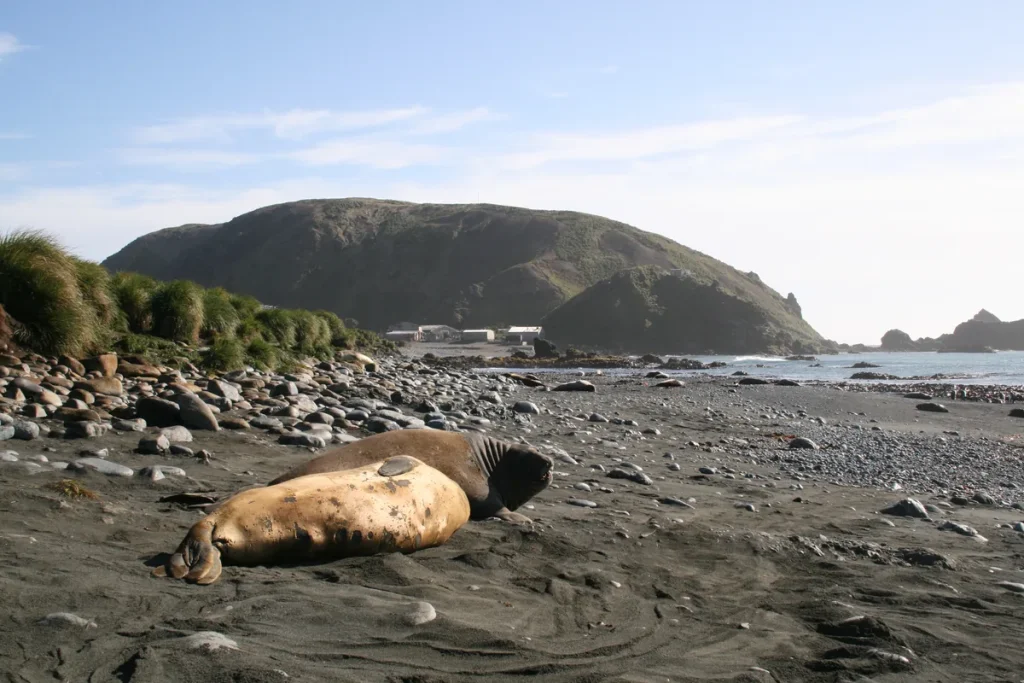
Thousands of elephant seals are born close to the station every spring, according to the Australian Antarctic Program.
ABC News reported fears that up to 90 per cent of baby elephant seals could perish, as happened on Heard Island over summer, where more than 13,000 pups are believed to have died from bird flu.
Mary-Anne Lea, an independent Southern Ocean marine mammal expert, said southern elephant seals were “very vulnerable to this disease”, ABC News reported. “That doesn’t mean that there will necessarily be a large outbreak at the site, although given it’s the breeding season and animals are aggregating at the moment, that would be a possibility,” she said.
Tasmania’s Wider Picture
As of Wednesday, Tasmania had recorded 50 bird flu events, with four new detections confirmed since 7 October, Pulse Tasmania reported. An event is one or more confirmed cases at the same location.
There have been no detections in commercial poultry or backyard flocks and no mass bird deaths in Tasmania, according to Pulse Tasmania.
What Authorities Are Asking of the Public
People should avoid touching sick or dead birds, ABC News and Pulse Tasmania reported. Sightings can be reported to the Emergency Animal Disease Hotline on 1800 675 888.
More coverage is in our Health section.
Sources: ABC News, “Bird flu detected in seals, birds from now-evacuated Macquarie Island”, 15 October 2026 (https://www.abc.net.au/news/2026-10-15/bird-flu-macquarie-island-southern-elephant-seal-kelp-gull/107271424); Pulse Tasmania, “Bird flu found in elephant seal on Macquarie Island”, 15 October 2026 (https://pulsetasmania.com.au/news/bird-flu-found-in-elephant-seal-on-macquarie-island/); Australian Antarctic Program, “Department of Climate Change, Energy, the Environment and Water to remove Australian Antarctic Program expeditioners from sub-Antarctic island as H5 bird flu threat approaches”, 28 August 2026 (https://www.antarctica.gov.au/news/2026/macquarie-island/)
Photo: MaccaPenguin, CC BY-SA 4.0, via Wikimedia Commons.
Young elephant seals rest on a Macquarie Island beach below the research station, pictured in December 2007; these animals are not the ones that tested positive.