The Australian Space Agency has unveiled the latest model of Roo-ver, Australia’s first lunar rover, as engineers ready it for a NASA mission to the Moon in 2030.
The rover was shown at the Queensland University of Technology’s lunar test facility in Brisbane on Wednesday 7 October, as part of World Space Week. It is due to land in the Moon’s south polar region.
Wednesday was a testing milestone. The model on show is one of several prototypes, and for now its work happens on Earth.
Roo-ver is due on the Moon in 2030. Would you watch its landing live?
Choose an answer, then select Vote.
What Was Shown in Brisbane
Roo-ver weighs about 20 kilograms, Nine and AAP reported. AAP said it is designed to work for one lunar day, about two Earth weeks.
Engineers are using the prototypes to test how the rover climbs, how it grips and how it copes with fine lunar dust, according to the Space Agency, Nine and AAP.
Enrico Palermo, head of the Australian Space Agency, said in the agency’s release: “Roo-ver is a representation of Australian ingenuity and innovation.”
Roo-ver director Ben Sorensen told 9News the rover marks a first for the country, covering every stage from design to operation.
“This is the first time that Australia has designed, built, and will test and then operate a lunar rover, a spacecraft, on another celestial body,” he said.
Bound for the South Pole
Roo-ver will travel on a NASA Commercial Lunar Payload Services mission to the lunar south pole in 2030, the Space Agency said. It will carry a NASA instrument to analyse lunar soil, known as regolith.
That means Roo-ver will reach the Moon as a payload on a NASA mission, not on a launch of its own.
The rover will be controlled from Australia, the agency said.
AAP reported the program is worth $42 million.
First Time, Every Time
Technical director Katie Doyle said the stakes were high, AAP reported.
“It needs to be able to operate first time, every time,” she said.
The climbing, grip and dust trials are how the team works towards that, finding problems at the Brisbane facility years before the rover is due to fly.
What Is Still to Come
What has not yet been shown is the rover that will fly. Wednesday’s model is one of several prototypes, and testing continues.
Keegan Buzza, from the Australian Space Agency, pointed to where the industry is heading.
“We’re expecting to see the global space economy triple over the next decade, so this is a really important economic proposition for Australia,” he told reporters at QUT.
Two Weeks on the Moon
Once it lands, Roo-ver will have about one lunar day to work, roughly 14 Earth days. In that time it will operate in the south polar region and use its NASA instrument to analyse the regolith, with control coming from Australia.
Roo-ver gives Australians watching the skies something new to follow. In January, wrp reported that the aurora australis could dazzle Australian skies as authorities tracked a severe solar storm. This time the object of interest is a rover on the Moon, controlled from Australia.
For now, the work is in Brisbane, where engineers are putting the prototypes through their trials ahead of the 2030 mission.
Sources: Australian Space Agency, “Australia’s Moonshot: New Roo-ver model unveiled”, 7 October 2026 (https://www.space.gov.au/news-and-media/new-roo-ver-model-unveiled-world-space-week-2026); Nine News, “Australia unveils its first moon rover ahead of 2030 space mission”, 7 October 2026 (https://www.nine.com.au/australia-news/qld/roover-australia-unveils-its-first-moon-rover-ahead-of-2030-space-mission-20261007-p613pc.html); Australian Associated Press, “Moonshot: lunar rover gets ready for launch”, 7 October 2026 (https://www.katherinetimes.com.au/story/9364453/moonshot-lunar-rover-gets-ready-for-launch/)
Illustration: AI-generated for WRP.
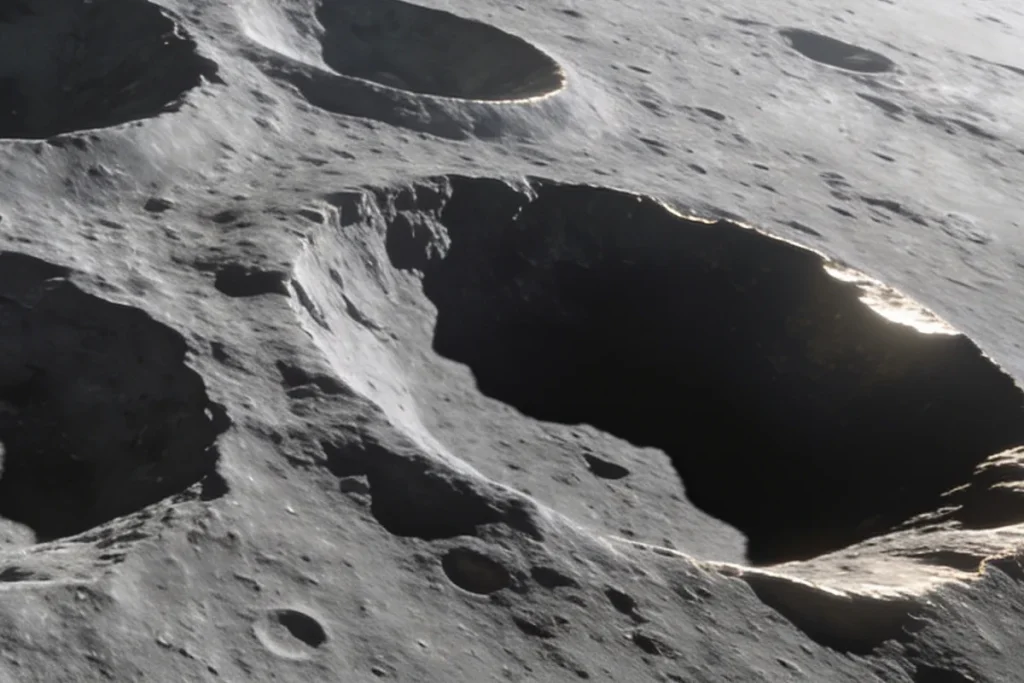
An imagined orbital view of the lunar south pole, where the sun never climbs far above the horizon and crater floors can stay in darkness. Roo-ver’s mission is aimed at this region; the rover itself is not shown.
Illustration: this image was generated by AI and is not a photograph of the Moon’s surface or of the Roo-ver rover.