
On Monday 26 October, the Commonwealth Ombudsman, Iain Anderson, published a report finding that the algorithm which decides how much home support older Australians get cannot legally be overridden, even when its result is clinically wrong.
The report, “Automation and oversight in Aged Care: October 2026”, is an own-motion investigation that runs to 104 pages, the Guardian reported. Its central finding is set out in one sentence.
“Currently, under the law, these automated decisions cannot be overridden and changed, even if they are clinically inappropriate.”
The investigation examined the Single Assessment System and its Integrated Assessment Tool, known as the IAT. The tool’s algorithm decides an older person’s Support at Home classification and priority, or whether they are eligible for the Commonwealth Home Support Program, according to the Ombudsman.
The numbers involved are large. About 1.1 million older people, 85% of the aged care population, received home support in 2023-24, the report says.
There is a limit to what the report claims. It does not establish that the algorithm actually produces clinically inappropriate outcomes. It says its findings raise serious questions about that, and it calls for an independent clinical review.
Should aged care assessors be able to override the algorithm?
Choose an answer, then select Vote.
A Technological Black Box
The second finding concerns transparency. No public information explains how the algorithm turns the inputs it is given into an outcome, according to the report, which calls it “a technological black box”.
That puts the department at odds with the robodebt royal commission. The report says the department has not complied with the commission’s recommendations 17.1 and 17.2 on transparency.
Anderson framed the problem as a question in an interview with Guardian Australia.
“How can you actually challenge decisions when you don’t know how they’re made by the algorithm?”
The report’s own conclusion is about confidence in the system. “Rather, a reasonable person would, in our view, lack confidence that the system is in fact fair and consistent.”
How the Department Handled It
The IAT in its current form was put in place without any meaningful risk assessment, evaluation or analysis, the Ombudsman found. The department “does not accept this characterisation”, ABC News reported.
The report also found that, until the Act and the Rules were introduced in October 2025, the department wrongly told assessment providers and the public that automated outcomes could be changed.
The algorithm launched on 1 November 2025. Appeals then rose more than five-fold on the previous year, according to ABC News.
The department also failed to enforce contractual quality controls or to check that assessors held the clinical qualifications they needed, the Guardian reported. The investigation began in April 2026, according to the Guardian.
What the Government Has Agreed To
The report makes 10 recommendations, and its response table sets out where the department stands on each.
The first two go to the central finding. Recommendation 1 asks for legislation so that assessment delegates can substitute their own decision, and recommendation 2 asks for the rules to be amended to match. The department noted both rather than accepting them, saying recommendation 1 is directed at the government.
It accepted five recommendations, numbers 3, 5, 6, 7 and 8, and accepted two more, numbers 4 and 9, in principle. Recommendation 10 asks the Australian National Audit Office to consider a performance audit.
Among the items accepted or accepted in principle are a comprehensive review of the Act and rules on needs assessment, public consultation before changes are made, plain-language fact sheets, publication of the algorithm’s business rules and a root cause analysis due in 2027.
The government has also moved on its own account. In the week before the report was released, it passed legislation for an “escalation pathway” in exceptional circumstances, and it has commissioned a review of the system and the algorithm due in the first half of 2027, ABC News reported.
Anderson doubts that the pathway goes far enough, according to the Guardian.
“I think that assessors being able to change decisions because they appear to be clinically inappropriate is really important, and so I am concerned that the escalation pathway will not necessarily do that,” he said.
In a joint statement, ministers Mark Butler and Sam Rae said, according to ABC News: “The government will consider the ombudsman’s report carefully as we continue to improve our aged care system, including the assessments system.”
Before the report, in September 2026, Clare Sullivan, chief executive of MND Australia, said, according to SBS News: “People living with MND do not have the luxury of waiting indefinitely for answers.”
More health coverage is in our Health archive.
Sources: Commonwealth Ombudsman, “Automation and oversight in Aged Care: October 2026” (https://www.ombudsman.gov.au/__data/assets/pdf_file/0019/331264/Automation-and-oversight-in-Aged-Care.pdf); The Guardian, “Unreasonable and unfair: damning investigation criticises Labor’s algorithm-based tool for aged care”, 26 October 2026 (https://www.theguardian.com/australia-news/2026/oct/26/damning-investigation-labor-algorithm-tool-aged-care-assessment); ABC News, “Aged care funding algorithm neither fair nor consistent, ombudsman finds”, 26 October 2026 (https://www.abc.net.au/news/2026-10-26/ombudsman-finds-automation-in-aged-care-lacks-safeguards/107308730); SBS News, “Robodebt recommendations not followed, outcomes ‘unfair’ under aged care algorithm”, 26 October 2026 (https://www.sbs.com.au/news/article/under-fire-aged-care-tool-offers-no-public-information-on-how-it-works-ombudsman-says/s6ev647y2)
Photo: KDPetersen, CC BY-SA 3.0, via Wikimedia Commons.
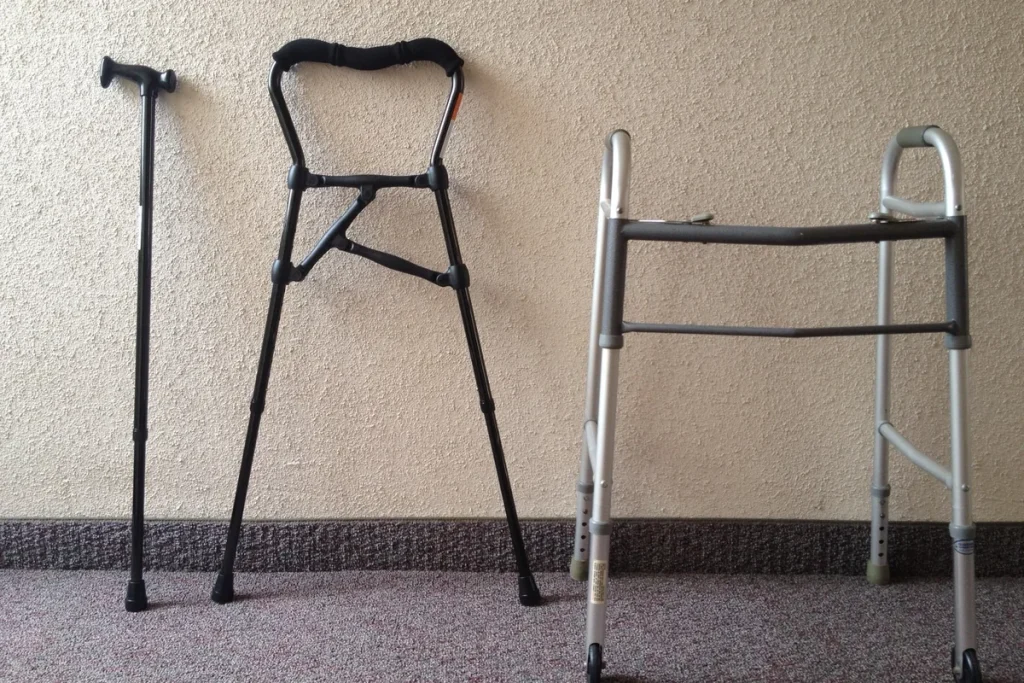
Illustrative: a walking cane, a hybrid cane and a walking frame, the kind of mobility aids many people receiving support at home rely on. It does not show anyone named in the report.