Aurora australis could dazzle Australian skies as authorities track ‘severe’ solar storm

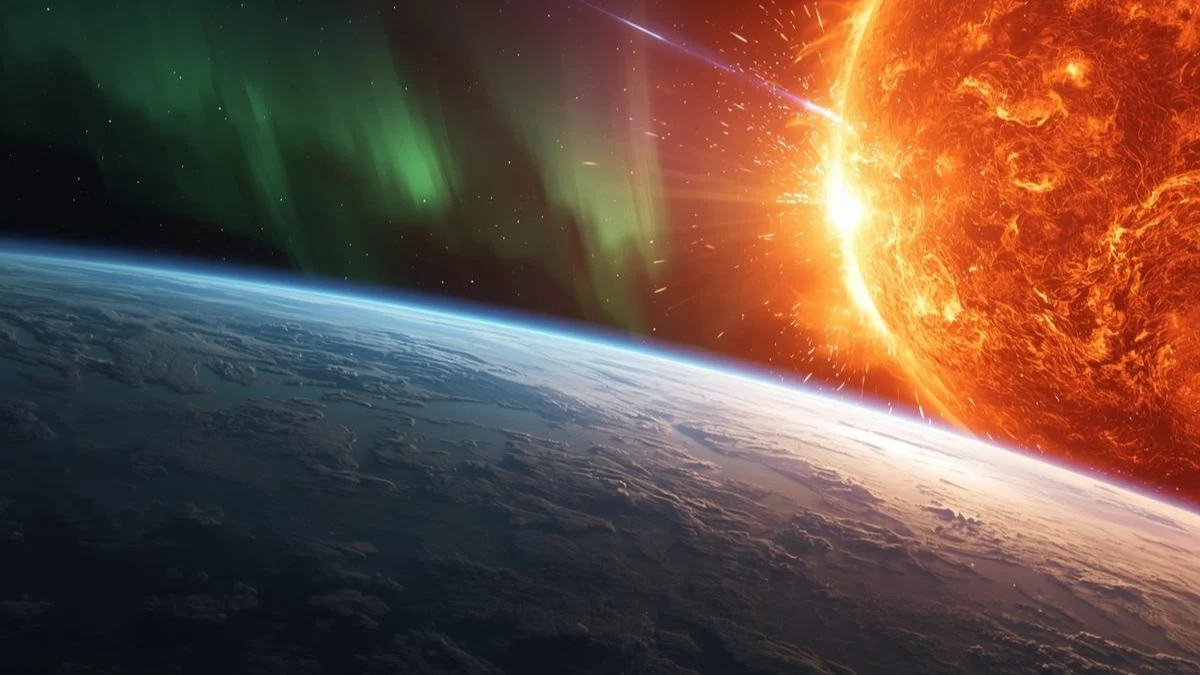
The aurora australis, or southern lights, could be visible across large parts of Australia, with sightings possible as far north as Victoria and New South Wales, as a severe solar storm reaches Earth.
The National Emergency Management Agency is monitoring the event, which may not only produce rare light displays but also pose potential risks to power grids, satellites, and GPS systems.
What is a solar storm?
A solar storm occurs when the sun releases bursts of energy, particles, and plasma into space. Australian astrophysicist and science communicator Sara Webb explains that these eruptions can sometimes be directed toward Earth.
“When that material collides with Earth’s magnetic field, it interacts with it,” Webb said, creating the glowing atmospheric phenomenon known as the aurora australis.
According to Webb, a significant solar flare erupted from the sun on 18 January and began impacting Earth late the following night.
Where and when can the aurora be seen?
The Bureau of Meteorology (BoM) issued an alert for 20 January, warning that a severe geomagnetic storm could make auroras visible during nighttime hours.
Under favourable conditions, BoM says the lights could be seen across middle latitudes, including parts of Victoria and New South Wales. Tasmania and New Zealand, being closer to the South Pole, are expected to have the best viewing opportunities.
Physicist Hannah Schunker from the University of Newcastle said proximity to the pole increases both the likelihood and intensity of aurora displays. However, she noted that Australians have been “quite fortunate” in recent years, with stronger-than-usual solar activity allowing sightings further north.
Clear skies, a dark location with minimal artificial light, and an unobstructed view of the southern horizon will improve chances of seeing the display. Auroras can appear suddenly and typically last anywhere from 20 minutes to an hour.
The storm’s effects will not be limited to the southern hemisphere. Webb said people in North America and Europe are also likely to see vivid auroras, known there as the northern lights, several hours before they become visible in Australia.
Shawn Dahl from the US National Oceanic and Atmospheric Administration told the Guardian the storm’s intensity is the strongest recorded in more than 20 years, raising the possibility of auroras appearing in regions where they are rarely seen.
Could technology and power systems be affected?
While the light show is the most visible outcome, solar storms can also disrupt modern infrastructure. Schunker explained that intense solar activity can temporarily weaken Earth’s magnetic shield, allowing charged particles to penetrate deeper into the atmosphere.
This can cause the ionosphere to expand and become denser, affecting satellite orbits and leading to GPS inaccuracies and communication errors. Rapid changes in the magnetic field can also induce powerful electrical currents, which have the potential to damage power grids.
“Hopefully, impacts on Australia and New Zealand will be minimal,” Schunker said, adding that severe consequences have occurred elsewhere in the past. Power and satellite operators are therefore closely monitoring conditions.
Webb said there is no immediate cause for alarm, but warned that the risk of disruptions is not zero. In extreme cases, geomagnetic storms have previously affected air traffic control systems and led to grounded flights.
“For people on the ground, there’s no danger,” Webb said. “If anything, we might be lucky enough to enjoy a spectacular aurora.”
Authorities in New Zealand have indicated that no significant impacts are expected. Transpower, the country’s electricity grid operator, said it is monitoring the situation but does not anticipate any disruption to consumer power supplies, noting contingency measures are in place if required.